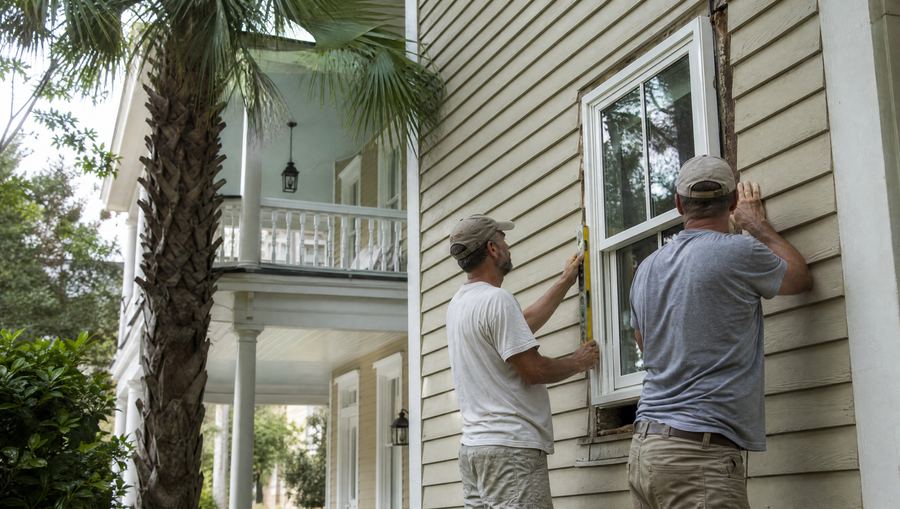
Replacement windows, matched to the opening
Every window is custom built to its opening and chosen for the way it opens, the room it serves and the sun it faces. Here is how the main styles compare.
| Type | How it opens | Best for | Typical installed |
|---|---|---|---|
| Double-hung | Slides up and down, both sashes | Historic and traditional homes | $750–$1,800 |
| Casement | Cranks outward on a side hinge | Kitchens, breezes, coastal seals | $850–$2,000 |
| Awning | Hinged at top, opens outward | Bathrooms, above fixed glass | $700–$1,600 |
| Picture | Fixed, does not open | Marsh and water views | $900–$3,500 |
| Sliding | Glides sideways on a track | Ranch homes, wide openings | $650–$1,500 |
| Bay & bow | Projects out from the wall | Light, seating, views | $3,500–$9,000 |
| Impact | Any style, laminated glass | Hurricane and debris zones | $1,400–$3,500 |
Also: specialty shapes, historic sash and energy-efficient glass. See all replacement windows.
Entry and patio doors that seal
Charleston humidity swells wood, salt eats hardware and wind-driven rain finds every weak sill. We replace the whole door system, frame and sill pan included.
| Type | Options | Typical installed |
|---|---|---|
| Entry door | Fiberglass, steel or wood | $2,000–$7,000 |
| Sliding patio | Two to four panels | $2,500–$7,500 |
| French patio | Hinged, in- or out-swing | $4,000–$10,000 |
| Impact door | Entry, French or sliding | $4,500–$12,000 |
| Storm door | Glass or screen over entry | $500–$1,500 |
See all door replacement options and the door cost guide.
Built for Lowcountry conditions
Hurricane exposure
Laminated impact glass installed exactly to its tested approval, so the protection is always in place.
Historic houses
Wood and wood-clad sash with matched muntins and profiles, plus lead-safe work on pre-1978 homes.
Heat and humidity
Low solar heat gain glass on sunny walls and a sealed, flashed install that keeps damp air out.
Signs your windows or doors are ready to replace
Most Charleston homeowners call us after noticing one of a handful of problems. Some are cosmetic, but most point to a window or door that has stopped doing its job of keeping heat, water and air outside.
- Fog, haze or droplets between the panes of glass, which means the insulated seal has failed
- Sashes that will not stay open, slam shut or are painted and swollen in place
- Drafts, whistling or visible daylight around a closed window or door
- Soft, dark or crumbling wood at sills, bottom rails and door jambs
- Water stains on the wall or floor below a window after a storm
- Sliding doors that drag, jump the track or need two hands to open
- Rooms on the sunny side of the house that stay hot no matter where the thermostat sits
One problem window does not always mean the whole house needs new windows. During the free estimate we look at every opening and tell you which ones truly need replacing now and which can wait.
Choosing a frame material
The frame decides how a window looks, how much care it needs and how well it handles heat and humidity. All four materials below can be built with low-E glass or laminated impact glass.
- Vinyl is the best value for most homes. Quality multi-chamber vinyl never needs painting, resists moisture and comes in white, tan and darker exterior colors. It is the most common choice for ranch homes, rentals and newer subdivisions.
- Fiberglass and composite frames expand and contract with the glass, so seals stay tight through Charleston summers. They can be painted, have slimmer sightlines than vinyl and suit dark exterior colors without warping.
- Wood-clad windows have a real wood interior and an aluminum or composite exterior skin. They give the look historic and high-end homes need with far less exterior maintenance than all-wood sash.
- All wood is still the right answer for some historic facades and review districts. It needs regular painting in our climate but can be repaired for decades.
We often mix materials on one house, for example wood-clad on the street-facing elevation and vinyl on the back, to meet design review rules while keeping the budget in check.
Glass for the Lowcountry sun
In Charleston the glass matters more than the frame. Our climate is cooling dominated, so the goal is to block the sun’s heat while keeping rooms bright. We look at three numbers on every window label: the solar heat gain coefficient (lower keeps heat out), the U-factor (lower insulates better) and visible transmittance (higher lets in more daylight).
For most homes we recommend double-pane insulated glass with a spectrally selective low-E coating, argon fill and warm-edge spacers. West and south elevations that bake in the afternoon can step up to a stronger solar control coating. Laminated impact glass adds another benefit: it blocks most of the ultraviolet light that fades floors, rugs and furniture, and it noticeably quiets traffic and wind noise.
Hurricane protection and local code
Much of coastal Charleston County falls in a wind-borne debris region. In those areas, building code generally requires replaced windows and glazed doors to be protected, either with impact-rated glass or with approved shutters. The requirement depends on your exact address and the design wind speed, so we confirm it during the permit process rather than guessing.
Impact windows only perform as tested when they are installed exactly as the product approval shows: the right anchors, spacing, embedment and sealant. We follow those instructions on every opening and keep the documentation for your permit inspection and your insurance agent, since some insurers offer wind mitigation credits for protected openings.
Historic homes and design review
Charleston has more historic housing than almost any city in the country, and its windows are a big part of why the streets look the way they do. Inside the city’s historic districts, window and door changes visible from the street generally go through the Board of Architectural Review. Mount Pleasant’s Old Village, Sullivan’s Island and many HOA communities such as Daniel Island and I’On have their own review processes.
We prepare what reviewers typically ask for: product drawings, profile sections, muntin and sash dimensions, photos of existing conditions and a clear scope. On contributing historic buildings we usually recommend wood or wood-clad windows that match the original lite pattern, and we give an honest opinion when restoring the original sash is the better path. Homes built before 1978 are handled with EPA lead-safe work practices.
Insert or full-frame installation
An insert replacement sets a new custom window inside the existing frame. It keeps your interior trim and exterior casing, goes in quickly and costs less, and it works well when the old frame is square, dry and solid. A full-frame replacement removes everything down to the rough opening. We use it when we find rot or water damage, when the original install was never flashed, or when the size or style of the window is changing.
Either way, the steps that make a window last here are the same: a sloped sill, flashing tape lapped so water runs out, low-expansion foam in the gap and a sealed interior. Exterior doors get a full prehung system with a sill pan, not just a new slab, because rotted jambs and leaking thresholds are the most common door problems we see.
How a project works
- Free in-home visit. We look at every opening and leave a written estimate.
- Precise measure. Each opening is checked for square, level and rot.
- Custom build. Windows and doors are made to order, usually in four to eight weeks.
- Installation. Most homes take one to three days, with cleanup and haul-away.
- Walkthrough. We show you how everything works and register your warranty.
Where we work
Charleston and the communities within about ten miles of the peninsula.
Common questions
Should I replace all my windows at once?
Not always. Replacing the whole house at once usually lowers the per-window price, but phasing the work, starting with the worst openings or the sunniest side, is a good option when budget is tight.
Will new windows lower my energy bills?
Homes replacing single-pane or clear-glass windows see the biggest difference, mostly in summer cooling. We focus on comfort and the right glass for each exposure rather than promising a set percentage.
Do you handle permits and HOA approvals?
Yes. We pull the building permit when one is required and prepare the product information and drawings for historic district or HOA review.
How much does window replacement cost in Charleston?
Most homeowners pay $750 to $2,000 per window installed. Impact windows run about $1,400 to $3,500 per window. A whole house of 15 vinyl windows commonly costs $12,000 to $21,000.
Do I need impact windows in Charleston?
Much of coastal Charleston County is in a wind-borne debris region where replaced windows and glazed doors generally need impact glass or approved shutters. We confirm the requirement for your address.
Can you replace windows on a historic house downtown?
Yes. We match original sash proportions and lite patterns in wood or wood-clad windows and prepare submittals for the Board of Architectural Review.
How long does it take?
Custom windows and doors usually take four to eight weeks to build. Most homes are installed in one to three days.
Is the estimate free?
Yes. We measure every opening, go over options and leave a written quote at no cost.